DATE_FORMAT
DATE_FORMAT has to be used in MySQL to format dates. It provides many formatting symbols to convert dates into any format you like.
Syntax:
DATE_FORMAT(date, format)Common format symbols:
| Symbol | Description |
|---|---|
%a | Abbreviated weekday name (Sun..Sat) |
%b | Abbreviated month name (Jan..Dec) |
%c | Month, numeric (0..12) |
%D | Day of month with English suffix (0th, 1st, 2nd, 3rd, ...) |
%d | Day of month, numeric (00..31) |
%e | Day of month, numeric (0..31) |
%f | Microseconds (000000..999999) |
%H | Hour (00..23) |
%h | Hour (01..12) |
%i | Minutes, numeric (00..59) |
%j | Day of year (001..366) |
%k | Hour (0..23) |
%l | Hour (1..12) |
%M | Month name (January..December) |
%m | Month, numeric (00..12) |
%p | AM or PM |
%r | Time, 12-hour (hh:mm:ss followed by AM or PM) |
%S / %s | Seconds (00..59) |
%T | Time, 24-hour (hh:mm:ss) |
%W | Weekday name (Sunday..Saturday) |
%w | Day of week (0=Sunday..6=Saturday) |
%Y | Year, numeric, four digits |
%y | Year, numeric (two digits) |
%% | A literal % character |
Examples
mysql> SELECT DATE_FORMAT(CURRENT_DATE,'%W %D %M %Y ');
+------------------------------------------+
| DATE_FORMAT(CURRENT_DATE,'%W %D %M %Y ') |
+------------------------------------------+
| Tuesday 19th July 2016                   |
+------------------------------------------+

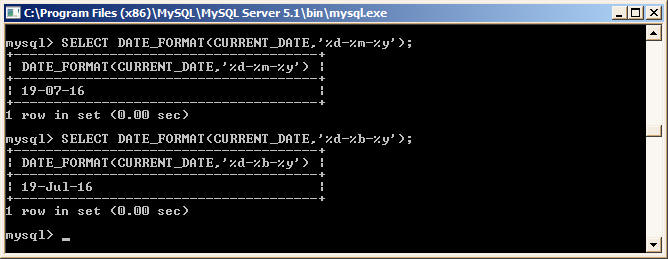
mysql> SELECT DATE_FORMAT(CURRENT_DATE,'%d-%m-%y');
+--------------------------------------+
| DATE_FORMAT(CURRENT_DATE,'%d-%m-%y') |
+--------------------------------------+
| 19-07-16                             |
+--------------------------------------+

mysql> SELECT DATE_FORMAT(CURRENT_DATE,'%d-%b-%y');
+--------------------------------------+
| DATE_FORMAT(CURRENT_DATE,'%d-%b-%y') |
+--------------------------------------+
| 19-Jul-16                            |
+--------------------------------------+